Queenstown’s transport future
Six strategic changes we need now
For years, Queenstown Lakes has been studying, modelling, consulting on and ‘business-casing’ transport change. Going back nearly a decade and starting with the Queenstown Integrated Transport Programme Business Case (2017) to the Wakatipu Active Travel Network Single Stage Business Case (2019), the Queenstown Business Case (2020), the Travel Demand Management SSBC (2023) and the Queenstown Public Transport Business Case (2024), the direction of travel has been remarkably consistent at a policy level.
The problem? It’s not that we don’t know what to do.
Lightfoot’s view… we’re still trying to solve a growth, climate, access and affordability challenge with a transport system that remains dependent on private cars. Growing pains of a small town growing into a big city? Six years ago we described the future of Queenstown as a congested concrete jungle… and guess what?
We need more decisive action to grow into the type of city people want to live in. Here’s our six cents worth of strategic shifts that are now beyond urgent.

Make mode shift the organising principle
Queenstown does not need more transport decisions that simply accommodate rising car use. It needs decisions that steadily reduce dependence on private vehicles.
That has been the direction of local public policy for years. The earlier programme business cases, the active travel work, the more recent travel demand management case, and the public transport business case all point to the same conclusion: if Queenstown wants a transport system that is efficient, affordable and lower-emissions, more everyday trips need to happen by bus, bike and foot.
What needs to change: every major transport investment should be assessed against one basic test: does it reduce car dependence at scale?
If it doesn’t, why are we doing it?

Prioritise a bus system people can trust
Public transport is no longer a fringe issue in Queenstown. The district has already built the case for a step-change in service, and recent patronage figures of 1.9 million bus trips in FY 2025 show the demand is there. And this is growing despite increases in fares. The first half of FY26 is up another 6%. What lets the system down is reliability, legibility and confidence.
For many people, especially workers, teenagers and households under financial pressure, public transport has to be dependable.
What needs to change: QLDC is the third partner in a ‘marriage of necessity’ with Waka Kotahi and Otago Regional Council. We are the Road Controlling Authority (RCA) for some but not all routes. The argument for bus lanes, flow lanes and clearways is stalled, with the excuse of “there’s no space” (not true) and “it’s too hard, it’s not our road” (sometimes true). We need better collaboration with Waka Kotahi to keep the buses moving through congested traffic. Lightfoot have identified kms of bus/flow lanes and clearways that will better prioritise buses.

Finish the active travel network as a real network
The strategic work on the active travel network is done. The Wakatipu Active Travel Network SSBC, finalised on 29 August 2019, set out the need for a clearly identifiable, connected network that links communities and key destinations.
The lesson is simple: disconnected paths (some with stairs) do not create mode shift. Networks do. Networks need to link into communities. If a confident 10-year-old or a cautious older rider cannot use it, it is not yet transport-grade infrastructure.
What needs to change: focus on continuity, safe crossings, school access, links to bus stops, the town centres, and routes that work for children, older people and less confident riders, not just the already-committed few. And please finish the footpath network in Frankton.

Use parking as a transport tool
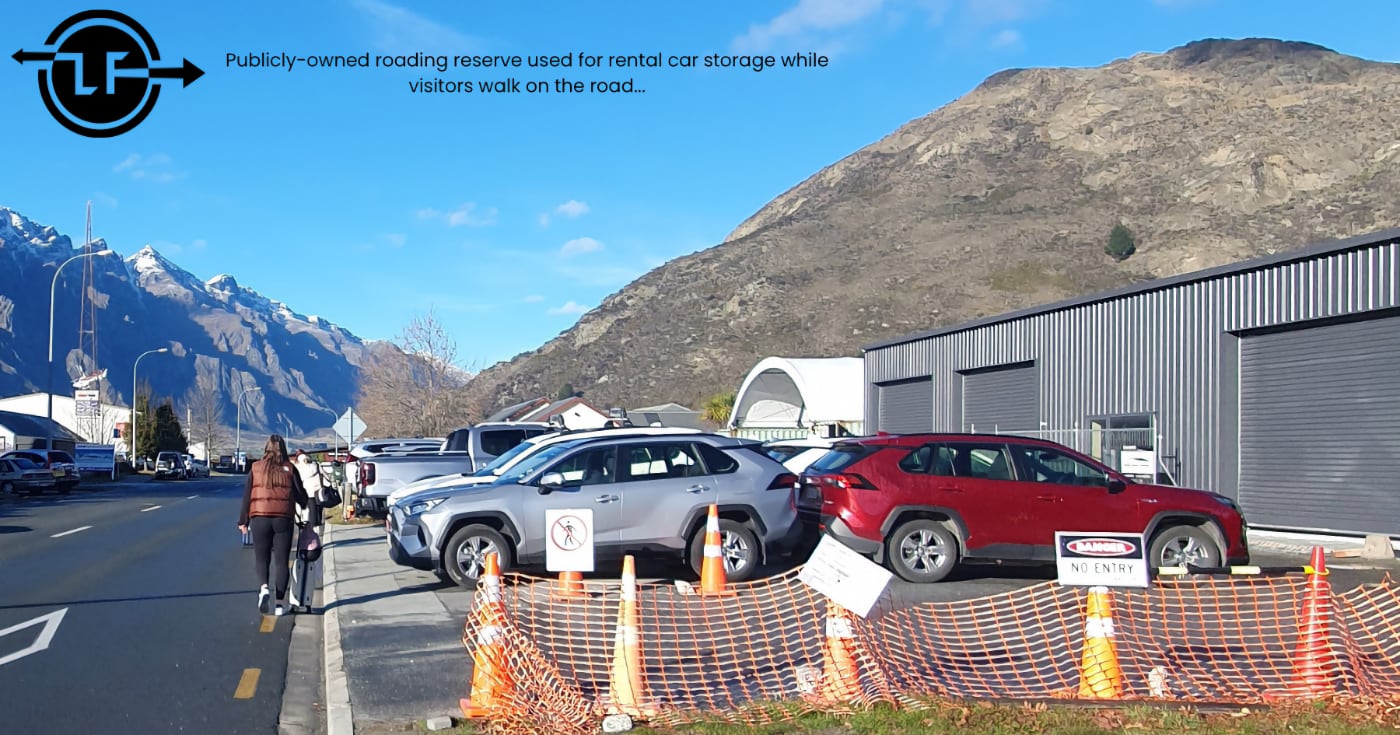
This is one of the clearest areas where the evidence is already on the table. Queenstown’s Parking Indicative Business Case (October 2017) and the draft Parking Strategy (October 2023) both show that parking policy is not separate from transport outcomes. Parking supply, pricing and allocation shape how people choose to travel.
If Queenstown says it wants mode shift while continuing to treat parking as a neutral public good, it will keep working against its own goals.
What needs to change: parking should support access, turnover, freight, public transport and safer streets, not reinforce a default assumption that every key destination must be reached and stored-at by private car.

Join up transport and urban development properly
The business-case trail also shows that transport problems in Queenstown are not just road problems. They are growth and land-use problems as well.
The Town Centre Masterplan Programme Business Case (November 2017) and the later Queenstown Business Case (November 2020) both sit within a broader story about growth, development pressure, movement and public space.
When homes, jobs, schools, visitor destinations and services are poorly connected, car dependence becomes structural. We have done major work on the District Plan and Spatial Plan, yet our new sub-divisions are below-par, crowded with cars parking on footpaths and no cycle lanes.
What needs to change: stop planning transport and urban development as adjacent conversations. New housing areas, worker accommodation, town centres and major visitor destinations should only proceed with credible non-car access designed in from the start. Queenstown will not “build its way out” of congestion with roading if it keeps reproducing long-distance commuting patterns.

Design for people with the fewest fallback options
A good transport system is not one that works only for confident drivers with flexible budgets. It is one that works for the people who most need real choices: young people, renters, shift workers, migrants, seniors, disabled people and families trying to get by with one car or none.
This is where transport becomes a community wellbeing issue, not just an engineering one.
What needs to change: let’s judge success on whether people can safely and affordably reach school, work, training, sport and services without needing a private vehicle for every trip. This requires a change in priorities. It pushes investment toward safe crossings, affordable fares, reliability, accessibility, bike education, wayfinding, and travel confidence, not just vehicle throughput.
The Bigger Point
Queenstown does not need to start the transport conversation again.
The district already has a substantial chain of adopted and endorsed work behind it: QITPBC (June 2017), Town Centre Masterplan and supporting business cases (November 2017), Wakatipu Active Travel SSBC (August 2019), Queenstown Business Case (November 2020 / endorsed January 2021), Parking Strategy (October 2023), TDM SSBC (December 2023) and Public Transport Business Case (April 2024).
What is needed now is political courage, alignment between agencies, and delivery at the pace the district’s growth demands.
Lightfoot’s view
If we want Queenstown to move better, we need to stop treating congestion as the problem in itself.
The deeper problem is overdependence on private cars in a place with limited space, rapid growth, high transport inequality and major climate obligations.
The answer is not one project. It is a system shift.
Written Submissions.
As community advocates for better transport networks we closely follow local, regional and national consultations and make sure we have our say.
Our priorities are firstly, ensuring that all future policy recognises the need for climate sensitive transport options – and secondly that transport networks provide equitable, safe, affordable and efficient solutions for all members of the community.
The scope of the change we’re facing is enormous and so we ensure that Lightfoot is contributing to cross-sector consultations as well as those focused on transport.